

Families and the Central Conflict: The Drama Expands the World, While the Novel Narrows Its Focus
Another major difference between Overdo and its source material lies in the scale of their conflicts.
The television adaptation builds an intricate world filled with multiple influential families, hidden conspiracies, shifting alliances, and political intrigue.
Support Layar Hijau
Layar Hijau is an independent media outlet dedicated to sharing news and stories about the Asian dramas you love. If you enjoy our content, your support helps us keep going and bring more stories to fellow drama fans.
Every bit of support means a lot to us. Thank you for reading, following, and being part of Layar Hijau's journey.
For supporters in Indonesia

For international supporters

For more information, click here.
The novel deliberately does the opposite.
The Drama’s Expanding World
The television series extends far beyond the relationship between Murong Qingyi and Ren Susu.
The Murong, Huo, and Li families all become central players in a much larger struggle for power.
The Huo family serves as one of the story’s primary antagonistic forces, with Huo Zongqi orchestrating the horrors of Ren’ai Orphanage and playing a major role in the conspiracy surrounding Susu’s family.
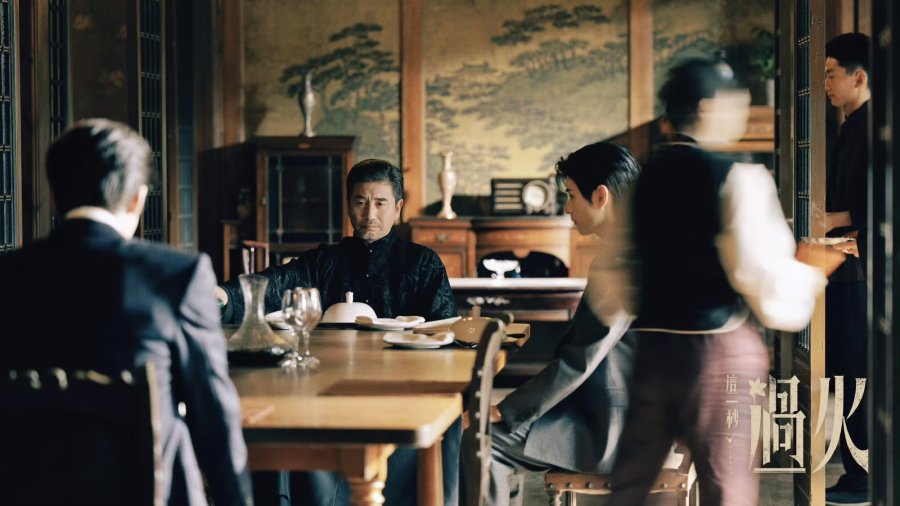
The Li family introduces the identity-swap storyline that shapes Qingyi’s childhood and complicates his relationship with both families.
Characters such as Murong Qingyu, Cheng Jinzhi, Sun Rongci, and many others each carry their own secrets and motivations, creating a web of political conflicts, betrayals, and revenge.
As a result, the drama feels expansive, with numerous storylines unfolding simultaneously.
The Novel’s Narrow Focus
The novel keeps its attention almost entirely on one place:
The Murong household.
There is no elaborate identity-swap.
No Huo family conspiracy.
No Ren’ai Orphanage.
No secret revenge organization.
Everything that destroys Ren Susu happens after she enters the Murong family.
The mansion itself becomes the novel’s primary symbol of feudal society.
Behind its grand gates lies a world built upon rigid class divisions, inherited authority, and the belief that a woman of humble origins can never truly belong among the ruling elite.
Fei Wo Si Cun demonstrates that oppression is not always loud or dramatic.
Sometimes it appears in daily humiliation.
In silent prejudice.
In countless small acts of exclusion that slowly break a person’s spirit.
The Real Villain
This difference also changes the identity of the story’s true antagonist.
The drama gives viewers clear villains to defeat.
The novel does not.
Its greatest enemy is the feudal system itself.
That system teaches powerful men that they are entitled to control the lives of women beneath them.
It encourages elite families to treat those of lower status as inherently inferior.
It allows ordinary people—including servants—to participate in cruelty simply because society permits it.
Rather than telling the story of heroes defeating villains, the novel asks a far more uncomfortable question:
What happens when an entire social system is built upon inequality?
Conclusion
Although Overdo and Fei Wo Si Cun’s original novel begin with the same characters, they ultimately tell two very different stories.
The television adaptation asks a hopeful question:
Can two wounded people overcome the tragedies of their past and finally find happiness together?
The novel asks something far more unsettling:
What happens when an unjust society permanently destroys the people living within it?
The title If I Hadn’t Met You at That Moment is not a romantic expression of destiny.
For Ren Susu, meeting Murong Qingyi marks the beginning of a lifetime of suffering.
What appears to be fate is, in reality, the moment her ordinary life is taken away forever.
Through that tragedy, Fei Wo Si Cun delivers a message that remains strikingly relevant today.
Love alone cannot overcome a society built on inequality.
Affection cannot erase violence.
Regret cannot undo years of emotional destruction.
Even redemption has limits.
While Overdo offers viewers an emotionally charged romance filled with mystery and revenge, the original novel stands as a powerful critique of feudal society and the lasting damage it inflicts on those with the least power.
That difference is precisely what makes the two versions so fascinating to compare.
They may share the same title and the same central characters, but they leave audiences with two entirely different understandings of love, power, and the price of living in an unjust world.
Chinese dramas products
Rosy Zhao Rosydoedian Authentic Dachshund Plush Doll Squeaky Soft Stuffed Decorative Throw Pillow Collectible Gift

Authenthic Dachshund plush doll from Zhao Lusi's Rosydoedian.
It's only available for shipping to certain countries.
Official Genuine Pursuit of Jade Drama Collectible Photocards Zhang Linghe Tian Xiwei Photo Trading Cards Holiday Gift

Official genuine collectible photocards These Pursuit of Jade Drama collectible photocards are officially licensed and authentic, featuring beloved characters Zhang Linghe and Tian Xiwei. Perfect for fans seeking genuine memorabilia from the popular drama.
New Drama Fangs Of Fortune Official Merch Collectible Cards Zhao Yuanzhou, Wen Xiao Characters HD Photocard Cosplay Gift

Official Merchandise from Fangs of Fortune This collectible card set is officially licensed Fangs of Fortune merchandise, featuring beloved characters Zhao Yuanzhou and Wen Xiao in high-definition detail for true fans.
