

LayarHijau – The release of Overdo, starring Zhang Linghe and Wang Churan, has quickly taken social media by storm. Even before the drama premiered, one particular scene had already gone viral: Zhang Linghe (190 cm) carrying Wang Churan (172 cm) through the rain in a soaked purple cheongsam. The leaked clip generated more than 100 million views in a single day, with fans praising the pair’s undeniable chemistry and calling the moment a textbook example of “sexual tension.”
At first glance, Overdo appears to be an epic romantic melodrama filled with revenge, hidden identities, political intrigue, and two lovers struggling against fate.
Support Layar Hijau
Layar Hijau is an independent media outlet dedicated to sharing news and stories about the Asian dramas you love. If you enjoy our content, your support helps us keep going and bring more stories to fellow drama fans.
Every bit of support means a lot to us. Thank you for reading, following, and being part of Layar Hijau's journey.
For supporters in Indonesia

For international supporters

For more information, click here.
However, readers of Fei Wo Si Cun’s original novel, If I Hadn’t Met You at That Moment (如果这一秒,我没遇见你), know that the source material tells a very different story.
Rather than being a sweeping romance, the novel is a devastating examination of the feudal social order during China’s Republican era—a society that crushes human dignity, particularly that of women born into the lowest social classes.
Warning: Major spoilers ahead. This article explores the fundamental differences between the original novel and its television adaptation.
Overview of the Original Novel: A Tragedy Built on Feudal Society
Anyone who has only watched Overdo might assume that Murong Qingyi and Ren Susu share a tragic love story that begins with fate and ends in heartbreak.
The novel tells a much darker story.
Murong Qingyi is the son of a powerful warlord family. Raised at the top of society, he grows up surrounded by privilege and authority. His social status allows him to pursue whatever he desires without ever questioning whether his actions are morally justified or harmful to others.
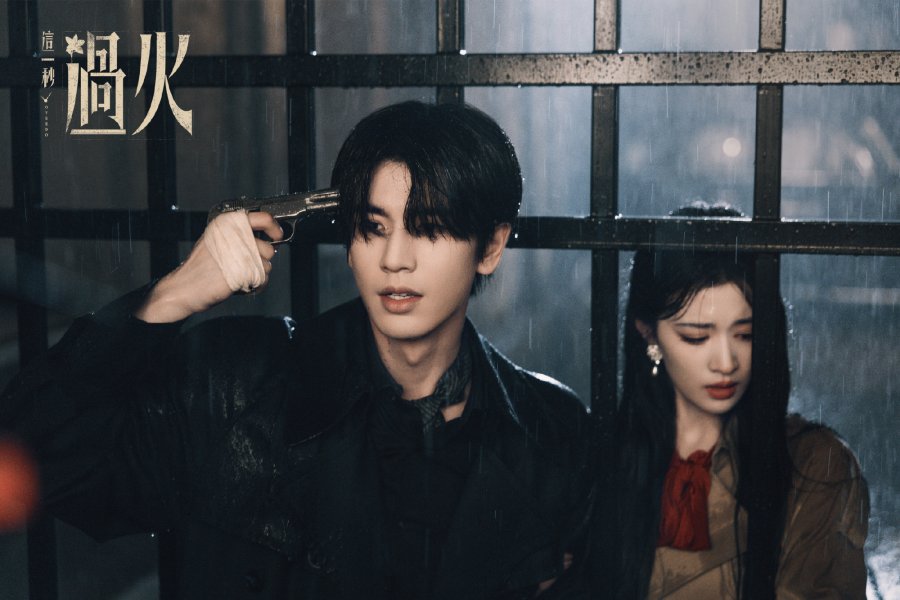
Ren Susu, by contrast, comes from the very bottom of society.
She is an opera performer (xi zi), a profession that, during the Republican era, carried enormous social stigma. Performers were often viewed as little more than commodities—people who could be bought, used, and discarded by those with wealth and power.
Their first meeting is not a romantic encounter destined by fate.
Qingyi rescues Susu from a runaway horse, but instead of developing a respectful relationship, he quickly becomes obsessed with her. He approaches Susu not as an equal but as a man convinced he has the right to possess whatever catches his interest.
Their relationship eventually turns into sexual violence. The novel makes it clear that their first sexual encounter occurs without Susu’s consent. Faced with a man from one of the region’s most powerful families, she has neither the social standing nor the ability to refuse him.
The assault leaves Susu pregnant.
She gives birth to a baby boy. At the time, Qingyi is abroad and completely unaware of the pregnancy. Unable to raise the child alone in her dire circumstances, Susu leaves him at an orphanage.
When Qingyi returns and forces a relationship with her once again, Susu is forced to tell him about their son. Qingyi immediately sends his men to the orphanage to retrieve the child. However, due to a mix-up, his men are wrongly informed that the baby has died of illness.
Their marriage is therefore not the result of a blossoming romance, as depicted in the drama. Instead, it is born from Qingyi’s profound guilt over the “death” of their firstborn, serving as another example of how a feudal society protects powerful men while forcing women to bear the consequences of their actions.
After they marry, they have a daughter. However, marriage does not improve Susu’s life.
She now lives in an elegant mansion, wears expensive clothes, and enjoys material comfort, yet she never becomes a true member of the Murong family.
To the family, she is simply a woman of inferior birth who has tainted the bloodline of a prestigious military household.
The servants openly disrespect her.
Relatives look down on her.
Humiliation becomes part of her daily life.
The greatest irony is that Qingyi never fully understands what she is enduring.
He believes that providing jewelry, luxurious clothing, and a beautiful home is proof of his love. What he fails to recognize is that Susu longs not for wealth, but for dignity, freedom, and genuine acceptance.
Rather than protecting her, Qingyi confines her within what is essentially a gilded cage.
He forbids her from working.
He discourages her from leaving the estate.
Every decision is made in the name of love, yet every decision strips away another piece of Susu’s independence.
Unlike many heroines in revenge dramas, Ren Susu never transforms into a fearless mastermind.
She does not assume a new identity.
She does not establish a secret organization.
She does not spend years plotting revenge.
Her dream is painfully modest.
She simply wants a peaceful home, a loving family, and a quiet life.
Even that modest dream is denied to her.
Years of emotional abuse slowly destroy her spirit, until it finally reaches a breaking point during the one-month celebration of their daughter.
Instead of celebrating, Murong Qingyi utters a cruel remark. He not only doubts the paternity of their newborn daughter but also callously implies that their firstborn son, who had “died” six years prior, might not be his biological child either.
This shatters Susu. She slaps him, runs out, and intentionally crashes her running car into a ginkgo tree.
Susu falls into a coma for over a month. Upon waking, her first request is a divorce. This is where the greatest misunderstanding that fuels his long-lasting resentment occurs: Murong Qingyi does not know that the family (specifically Madame Murong) orchestrated a fake death. The Murong family announces to the public that Ren Susu has died in the accident, gives her a new identity as “Fang Mulan,” and sends her abroad.
However, the narrative Murong Qingyi is led to believe is that Ren Susu intentionally chose death to escape and abandon him and their infant daughter. The belief that the woman he loved (and had hurt) cruelly deserted their child is what fills him with deep anger, heartbreak, and resentment toward her for years to come.
As a result of this tragedy, their two children grow up in completely different worlds, shrouded in misunderstandings.
Their daughter is left behind and raised by the Murong family. She grows up without ever knowing her mother, surrounded by relatives who likely continue to look down on the woman who “betrayed” them.
Meanwhile, their firstborn son never actually died; there had simply been an identity mix-up at the orphanage. He grows up as an orphan and is adopted by a primary school teacher when he is around ten years old, taking her surname to become Zhuo Zheng. Raised without his biological parents, he grows into a 23-year-old young man who is the physical spitting image of Murong Qingyi, yet views him as a complete stranger.
For 17 years, both Qingyi and Susu lived with the false belief that their firstborn son had died. Susu never knew Zhuo Zheng was alive, and she carried the grief of losing him throughout her exile.
Seventeen years later, Murong Qingyi finally uncovers the truth about the identity mix-up at the orphanage and finds their now-adult son, Zhuo Zheng. It is Qingyi who brings this news to Susu. Upon hearing that her son is alive, Susu feels as though she is dreaming.
For nearly two decades, Murong Qingyi lived trapped in a cycle of anger and regret, believing Susu had intentionally chosen death to abandon him and their infant daughter, only to realize he had harbored resentment toward a false narrative all along.
When they finally reunite, Susu does not scream. She does not cry. She does not seek revenge. Instead, she greets him with quiet politeness and emotional distance.
That silence becomes Qingyi’s greatest punishment. The woman standing before him is alive, but the love she once held for him died many years ago alongside the “Ren Susu” he thought he had lost.
In the end, Susu returns to Qingyi—not because everything has been forgiven, but because time, exhaustion, and the desire to piece together what remains of their shattered family leave little else to hold onto.
Qingyi spends the rest of his life trying to atone for mistakes that can never truly be erased.
The novel ends not with romantic fulfillment, but with lifelong regret.
Chinese dramas products
Rosy Zhao Rosydoedian Authentic Dachshund Plush Doll Squeaky Soft Stuffed Decorative Throw Pillow Collectible Gift

Authenthic Dachshund plush doll from Zhao Lusi's Rosydoedian.
It's only available for shipping to certain countries.
Official Genuine Pursuit of Jade Drama Collectible Photocards Zhang Linghe Tian Xiwei Photo Trading Cards Holiday Gift

Official genuine collectible photocards These Pursuit of Jade Drama collectible photocards are officially licensed and authentic, featuring beloved characters Zhang Linghe and Tian Xiwei. Perfect for fans seeking genuine memorabilia from the popular drama.
New Drama Fangs Of Fortune Official Merch Collectible Cards Zhao Yuanzhou, Wen Xiao Characters HD Photocard Cosplay Gift

Official Merchandise from Fangs of Fortune This collectible card set is officially licensed Fangs of Fortune merchandise, featuring beloved characters Zhao Yuanzhou and Wen Xiao in high-definition detail for true fans.
