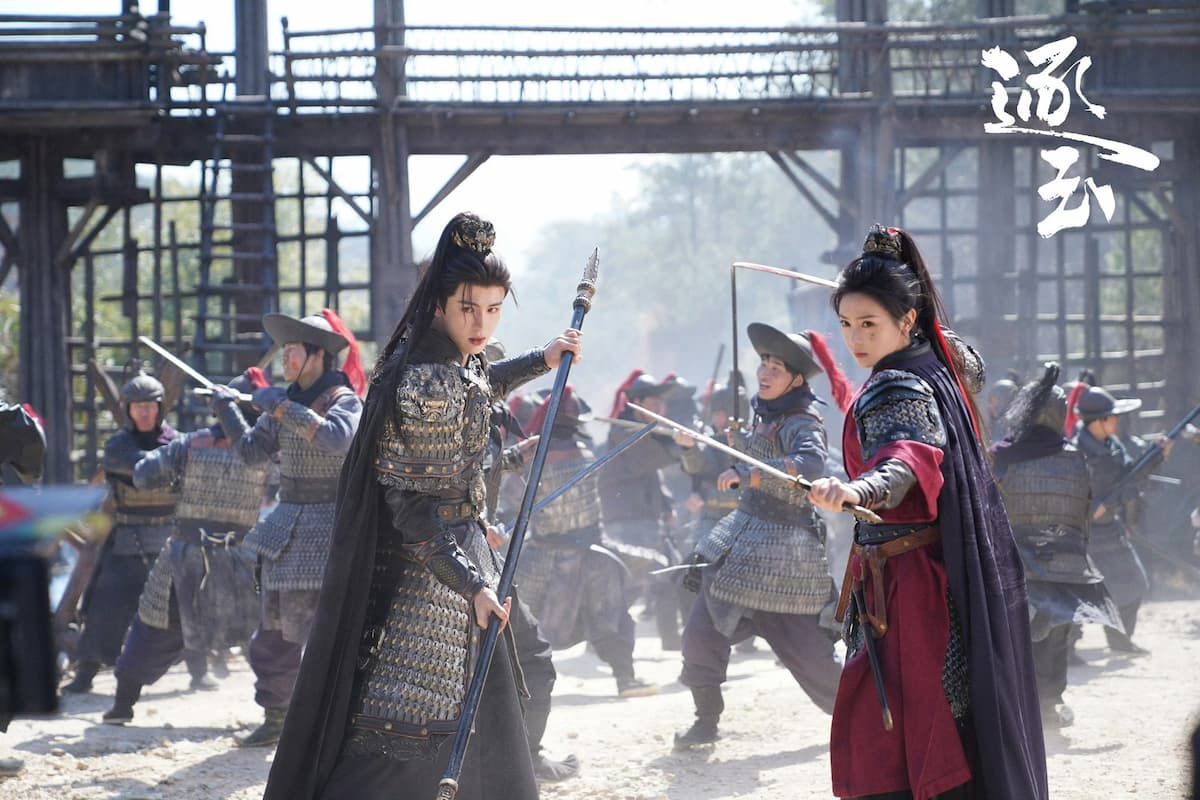
LayarHijau – The Chinese drama Pursuit of Jade (逐玉), which officially aired its final episode on March 26, 2026, continues to spark discussion among viewers. Beyond its intricate storyline, one of the most talked-about aspects is the significant difference in Fan Changyu’s family background between the original novel and its drama adaptation.
Spoiler Alert: This article contains major plot details from both the novel and the drama.
Next articles


In the story, Fan Changyu’s origins are not just a minor detail, but a crucial element that shapes the political conflicts, character relationships, and Xie Zheng’s emotional dilemma. However, the drama simplifies many of these elements compared to the novel.
In the novel, Fan Changyu’s family background is far more complex. Her grandfather is General Meng Zhuyuan, a key military figure serving under Xie Linshan, Xie Zheng’s father. Meanwhile, her father, Wei Qilin, has a dark past. He was bought by the Wei family as a child and trained as an assassin. Due to his exceptional strength and martial arts skills, he eventually became part of the Wei family’s core forces.
The connection between the Xie and Wei families deepened after Wei Wan, Wei Yan’s younger sister, married Xie Linshan. From that point on, Wei Qilin served under Xie Linshan and earned recognition from Meng Zhuyuan. Eventually, Meng Zhuyuan married his daughter, Meng Lihua, to Wei Qilin. From this marriage, Fan Changyu and Fan Changning were born.
The major conflict began when Jinzhou, a border city of the Da Yin Kingdom, was attacked by the Northern Yue army. Xie Linshan and Crown Prince Chengde led the defense, but they faced severe shortages of troops and supplies. The emperor then ordered General Meng Zhuyuan to deliver provisions to Jinzhou, accompanied by the Sixteenth Prince—his beloved son born to Consort Jia. The emperor had even considered naming the Sixteenth Prince as crown prince, but ultimately abandoned the idea due to Crown Prince Chengde’s strong support among officials and the public.
The situation took a drastic turn when the Sixteenth Prince attempted to rescue Luo City, which was also under attack, only to be captured. The Northern Yue forces threatened to kill him unless the supplies were handed over. Meng Zhuyuan sought instructions from the emperor and received a reply in the form of a letter from Wei Yan along with the Tiger Tally, granting military authority.
In that letter, Wei Yan instructed Meng Zhuyuan to rescue the Sixteenth Prince in Luo City, while the supplies for Jinzhou would be rerouted through Chongzhou. Wei Qilin was tasked with carrying the Tiger Tally to meet Sui Tuo, the ruler of Chongzhou—later known as Prince Changxin—and request that his troops deliver provisions to Jinzhou.
However, the plan ultimately failed. Both Luo City and Jinzhou fell. Xie Linshan, Crown Prince Chengde, and the Sixteenth Prince all died. Wei Qilin disappeared, and the reason behind his failure to mobilize Chongzhou’s forces was deliberately erased from the investigation. In the end, Meng Zhuyuan was made the scapegoat and branded a traitor in the eyes of the public.
Behind the scenes, the truth was far more complicated. Wei Yan and Sui Tuo were secretly colluding in a power struggle, while the emperor himself had already planned to eliminate Crown Prince Chengde and Xie Linshan.
One of the key triggers behind the emperor’s suspicion was an earlier flood disaster. At that time, Crown Prince Chengde had been assigned to deliver relief aid to affected civilians. However, the Jia family—relatives of Consort Jia, the mother of the Sixteenth Prince—deliberately obstructed the distribution process. As a result, the aid arrived too late, causing significant casualties.
Instead of investigating the truth, the emperor blamed Crown Prince Chengde entirely. This incident highlighted his favoritism toward Consort Jia’s family and deepened his distrust of the crown prince.
His suspicion was further reinforced after receiving reports about Wei Yan’s drunken remarks. During a private meeting with the crown prince’s trusted circle, Wei Yan had suggested that overthrowing the emperor might be a solution to the injustice faced by the crown prince. This statement became the emperor’s justification for taking extreme measures.
The war in Jinzhou was then used as an opportunity to eliminate both Crown Prince Chengde and Xie Linshan. All of these truths were hidden from the public, leading Xie Zheng to believe that the Meng family was responsible for his father’s death. This misunderstanding becomes a major source of his inner conflict upon discovering Fan Changyu’s true identity.
In contrast, the drama adaptation significantly streamlines the storyline. General Meng Zhuyuan is completely removed, and the narrative focuses directly on Wei Qilin. In this version, Wei Qilin is tasked with delivering the Tiger Tally to request reinforcements from Prince Changxin, but fails, leading to Jinzhou’s fall.
As a result, Wei Qilin is directly labeled a traitorous general by the public, without the layered political complexity seen in the novel. The drama also alters the power dynamics by portraying the late emperor as actively colluding with Prince Changxin to eliminate Xie Linshan and Crown Prince Chengde.
Palace intrigue remains central to the story, but it is presented in a more straightforward way. The emperor lures Wei Yan back to the capital using Consort Su, only for Wei Yan to ultimately turn the tables—ending the emperor’s life and installing Qi Sheng as the new ruler.
These changes make the drama more accessible to general audiences, but they also reduce the political depth and moral complexity that define the original novel.
However, by the end of both the novel and the drama, one major mystery remains unresolved: Wei Yan’s true motives. Crown Prince Chengde was the very prince he supported to ascend the throne, while General Xie Linshan was not only his ally, but also his close friend and the husband of his sister, Wei Wan.
This raises a lingering question—did Wei Yan deliberately allow their deaths during the defense of Jinzhou as part of a larger scheme? Or was he actually trying to save them, only for his plan to fail? It is also possible that his sudden return to the capital for Consort Su became the turning point that caused everything to collapse.
This ambiguity leaves Wei Yan as one of the most morally complex characters in the story—a man standing at the intersection of loyalty, ambition, and possible betrayal, whose true intentions remain open to interpretation.