LayarHijau – AI-generated short dramas are beginning to reshape China’s short-drama industry. In recent months, AI productions have not only surged in volume but have also started taking over the top spots in viewer numbers on major platforms. The shift is now drawing a response from Chinese regulators, who are increasing support for high-quality live-action productions while tightening rules governing AI-generated content.
China’s Short-Drama Market Continues to Grow
The scale of the shift is particularly clear from data released by Hongguo Short Drama, one of China’s major short-drama platforms. During the 2026 summer season, Hongguo recorded 5.94 billion viewer visits, 235 million reservations, and 5.47 billion brand impressions across the internet. The number of viewer visits was up 546% from the 920 million recorded during the same period last year.
Next articles


The growth shows that China’s short-drama market as a whole is still expanding rapidly. But that growth has not been evenly distributed between live-action short dramas and AI short dramas.
According to an analysis by Sohu Entertainment, live-action short dramas continue to attract large audiences, but they are finding it increasingly difficult to produce titles capable of becoming major breakout hits on the scale seen last year.
During the 2025 summer season, Hongguo’s top short dramas included one title with more than 3 billion views, another with more than 2 billion, and four others that surpassed 1 billion. This year, only one live-action short drama surpassed 2 billion views in a single month: Good Rain Knows Its Season (好雨知时节), starring Guo Yuxin and Wang Haozhen.
Six other live-action short dramas also surpassed 1 billion monthly views, including Gradual Dyeing (渐染), Concealing Beauty in the Capital (娇藏京枝), I Do Homework to the Sound of Mahjong and Make a Comeback Against the Odds (在麻将声中写作业,我逆风翻盘了), My Husband Changed His Heart Before the Wedding, So I, a Spoiled Young Master, Tread the Clouds (婚前夫君变了心,我执纨绔踏青云), Moving Nest (移巢), and Spring Boudoir Behind the Vermilion Gate (朱门春闺).
Several of these titles do not have confirmed official international English titles. The English titles used here are literal translations of the original Chinese titles rather than official international titles.
In other words, live-action short dramas are not losing their audiences altogether. The bigger change is that fewer live-action titles are breaking into the very top tier.
Sohu Entertainment described the shift this way: “The number of viewers for live-action short dramas has not declined, but there is a lack of titles capable of breaking through and becoming major hits.”
AI Short Dramas Take Over the Top Spots
At the same time, much of the growth in the highest-viewed tier is increasingly being driven by AI short dramas.
Several AI titles mentioned in the report have surpassed 10 billion cumulative views. They include Sword Sect’s Beloved Junior Sister (咱家剑宗团宠小师妹), Su Yi Enters a Book (苏忆穿书), Record of Ten Thousand Demons (万妖图录传), Who Still Pretends to Be a Rich Second Generation After Rebirth? (都重生了,谁还装富二代啊), Mistaking My Flash-Married Husband for an AI (错把闪婚老公当作AI), and Back to the Millennium, I Survive by Making a Living from the Sea (重回千禧我靠赶海养活家人).

These titles do not have confirmed official international English titles. The English versions used here are literal translations of their Chinese titles and should not be interpreted as official international titles.
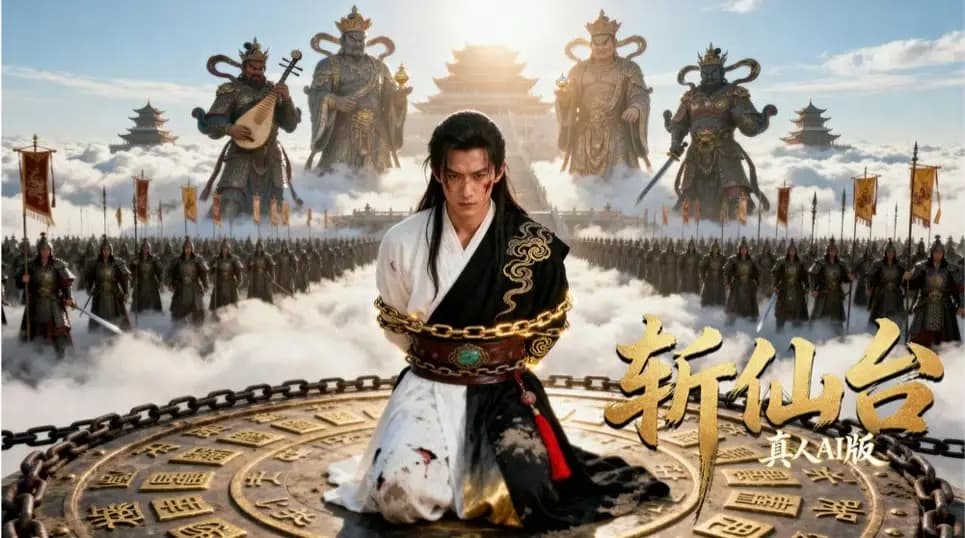
The shift becomes even more striking when looking at Hongguo’s most popular short dramas on August 22. Only one of the platform’s top 10 titles was a live-action short drama. The other nine were AI productions, including AI animation and productions featuring digitally generated human-like characters.
That makes the ranking one of the clearest indicators yet that AI is becoming a major force in the race for the highest audience numbers in China’s short-drama market.
Sohu Entertainment wrote that “a large share of the additional audience has been absorbed by AI short dramas.” The report also said that AI short dramas had “broadly reshaped the balance of power” within the industry during the 2026 summer season.
AI Opens Up Stories That Are Hard to Produce in Live Action
The shift is not simply the result of AI’s ability to produce content at scale. The technology is also making it easier to pursue genres that can be difficult or expensive to execute in live action.
Genres such as cultivation fantasy, alternate worlds, reincarnation stories, as well as war and power struggles can be produced more flexibly with AI technology.
Advances in AI models and related production tools throughout 2026 have also made the technology easier for industry players to adopt. According to Sohu Entertainment’s analysis, improvements in AI models and products helped make the technology increasingly accessible during the summer season.
The growing popularity of serialized production is another important factor. An AI drama does not necessarily have to start from scratch after a successful title attracts an audience. Characters, fictional worlds, visual assets and production styles can be carried over into subsequent seasons.
DataEye analysis cited by The Paper shows how widespread that model has become among AI dramas on Hongguo.
In August 2026, 311 3D animated titles appeared on Hongguo’s AI drama list, accounting for about 81% of all titles on the list. AI dramas featuring human-like characters accounted for another 64 titles, or approximately 16.84%.
The three titles with the highest peak popularity on the list were all 3D animated productions. Record of Ten Thousand Demons Season 11 (万妖图录传第十一季) reached a peak popularity score of 124 million, followed by Record of Ten Thousand Demons Season 10 (万妖图录传第十季) at 117 million and Sword Sect’s Beloved Junior Sister Season 3 (咱家剑宗团宠小师妹第三季) at 115 million.
The titles also highlight the growing importance of serialization in AI drama production. A total of 305 titles, or about 80.2% of the list, were part of a series. Overall, serialized productions accounted for roughly 81.16% of the list’s total peak popularity.
This production model offers advantages that can be difficult for live-action productions to match in certain areas. Once the characters, fictional world, visual assets and production style have been established, another season can be developed without having to coordinate actor schedules, locations, large production crews, costumes and extensive production design on the same scale.
AI Production Has Reached Mass Scale
The scale of the shift becomes even clearer in data released by Chinese regulators.
On September 17, Wang Xiaoliang, head of the National Radio and Television Administration’s Department of Online Audiovisual Program Management, said China’s short-drama audience had surpassed 800 million users. The short-drama market was also worth more than RMB 1 trillion in 2025.
During the first eight months of 2026 alone, 430,000 short dramas were released—13 times the number produced throughout 2025.
The most striking figure was the share of AI productions. According to data presented at the press conference, AI dramas accounted for more than 90% of all productions.
That figure shows that AI is no longer simply an experimental format within China’s short-drama industry. The technology is now being used on a massive production scale.
China Tightens Rules for AI Short Dramas
The rapid expansion of AI has now become a regulatory issue in its own right. But the Chinese government has not responded by shutting down AI drama production.
Instead, regulators are acknowledging the technology’s potential while establishing clearer rules for how it can be used.
Wang said AI technology has “opened up new possibilities for reducing costs, improving efficiency and creating new forms of expression” in short dramas. At the same time, he said the technology has created new challenges involving rights protection and content quality.
As a result, regulators are requiring AI-generated short dramas to carry clear content labels. Platforms must also pay close attention to rights involving the use of people’s faces and voices and conduct oversight throughout the production and distribution process.
“Ultimately, AI is a tool, while people remain the creators,” Wang said. “The faster AI dramas develop, the more important it is to maintain content quality.”
The new requirements are not merely proposals. China’s Short Drama Development and Management Regulations took effect on September 1, 2026. The rules specifically require short dramas created or produced using AI technology to carry clear AI-content labels on every episode in accordance with applicable requirements.
The regulations also place greater responsibility on platforms. Service providers must establish content-review mechanisms, ensure that the works they distribute meet regulatory requirements, and monitor both content and accounts involved in distributing short dramas.
Regulators have also called on platforms to evaluate the recommendation algorithms used for short dramas and prohibit algorithmic systems designed to encourage addictive use or excessive consumption.
Live Action Gets More Government Support
At the same time, the Chinese government is not only regulating AI. Regulators are also explicitly strengthening support for live-action short dramas as part of a broader effort to improve the quality of the industry.
At the September 17 press conference, Wang said, “Live-action dramas are the main force behind high-quality production and should receive strong support.”
That support includes further implementation of the High-Quality Short Drama Creation and Distribution Program. Platforms are also being directed to create dedicated sections for live-action dramas and provide financial support so that high-quality productions “have a market and receive returns.”
The government’s approach therefore runs on two tracks at once: AI innovation remains encouraged, but its use is subject to tighter rules, while high-quality live-action short dramas receive stronger support.
Most AI Dramas Targeted in Regulatory Crackdown
The increased oversight has also led to concrete enforcement actions.
According to Wang, Chinese regulators removed 68,000 short dramas deemed to have violated regulations during 2026 and directed platforms to address more than 1,200 problematic accounts. More than 90% of the content handled in those operations was AI-generated drama.
The figures illustrate the scale of the regulatory challenge created alongside the growth of AI production. As the volume of AI-generated content increases, regulators face a larger task in monitoring content quality, rights involving people’s faces and voices, and compliance with content rules.
That does not mean live-action short dramas have lost their entire audience. Hongguo still has a number of live-action titles that surpassed 1 billion to 2 billion views during the 2026 summer season. The data instead points to a growing difficulty for live-action productions to dominate the highest-viewed tier in the way some titles did previously.
The latest developments are therefore better understood as a shift in the balance of China’s short-drama industry.
AI short dramas have evolved from an alternative format into a major source of production and audience numbers, particularly on platforms such as Hongguo. At the same time, the Chinese government is responding by keeping the door open to AI innovation, tightening rules around its use, and strengthening support for high-quality live-action short dramas.
With hundreds of thousands of productions released in just eight months, the competition between AI and live action in China’s short-drama industry has entered a new phase. The question is no longer whether AI can produce short dramas, but how the industry can maintain quality when AI production can be scaled so rapidly, while regulators work to ensure that growth continues to respect copyright, rights involving faces and voices, AI labeling requirements and accountability for content.