

LayarHijau— The upcoming drama starring Lin Yi and Lu Yuxiao, When I Meet the Moon, has recently released a new trailer that highlights Yun Li’s emotional journey as she pursues her feelings for Fu Shize. In the preview, Yun Li, played by Lu Yuxiao, is shown boldly chasing love, while Lin Yi’s character struggles with internal conflict.
The drama has become one of the most anticipated titles as it is adapted from Zhu Yi’s novel Fold the Moon, part of the Nanwu-Yihe trilogy. The other two entries, Hidden Love and The First Frost, were both successfully adapted into hit dramas, gaining strong popularity in China and internationally.
Support Layar Hijau
Layar Hijau is an independent media outlet dedicated to sharing news and stories about the Asian dramas you love. If you enjoy our content, your support helps us keep going and bring more stories to fellow drama fans.
Every bit of support means a lot to us. Thank you for reading, following, and being part of Layar Hijau's journey.
For supporters in Indonesia

For international supporters

For more information, click here.
However, even before its official release, an unexpected issue has already surfaced on YouTube. In recent months, LayarHijau has identified multiple channels using images of Lin Yi and Lu Yuxiao as thumbnails for uploaded drama content.
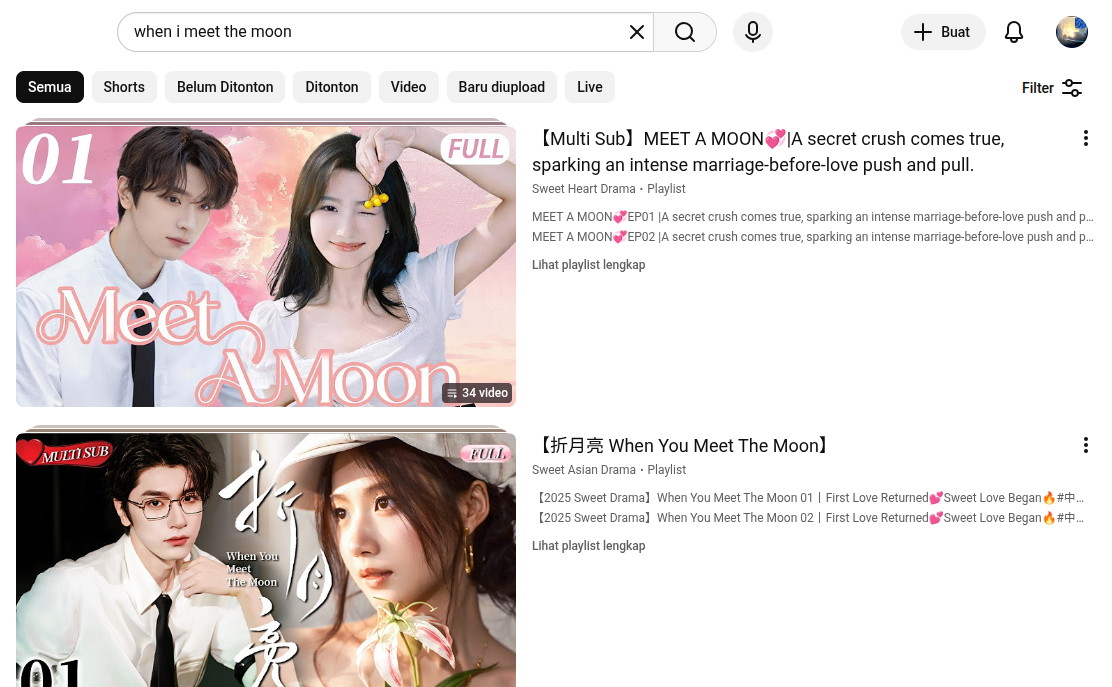
These channels also use identical or slightly altered titles such as “Meet a Moon” or “When You Meet the Moon,” making it appear as though the videos are related to the upcoming drama.

Clicking on one of these videos reveals something entirely different. Instead of the new series, the content features Memory Of Encaustic Tile, starring Lin Yi and Yukee Chen, which previously aired on Youku, Viu, and Viki. At least two channels have uploaded full episodes under modified titles while using misleading thumbnails. One such video has reached around 29,000 views, while others have gained tens of thousands.
LayarHijau also identified one channel that created a fake When I Meet the Moon trailer using AI, where the characters’ faces do not match the real actors, further misleading viewers.
It remains unclear whether the official rights holders are aware of these uploads. However, the situation highlights the growing issue of reuploaded and manipulated drama content on YouTube.
This phenomenon is not limited to Chinese dramas. Similar practices can also be found across Korean dramas and Hollywood series, where full episodes or edited clips are reuploaded under misleading titles and thumbnails.
As a platform, YouTube relies on its Content ID system to detect copyright violations. Through this system, rights holders can choose either to remove videos or to claim their ad revenue.
In practice, real-world experiences suggest that enforcement is not always consistent. LayarHijau previously uploaded a review video of the Korean drama The Penthouse, using only a few seconds of footage as part of the discussion. The video was initially published without any issues.
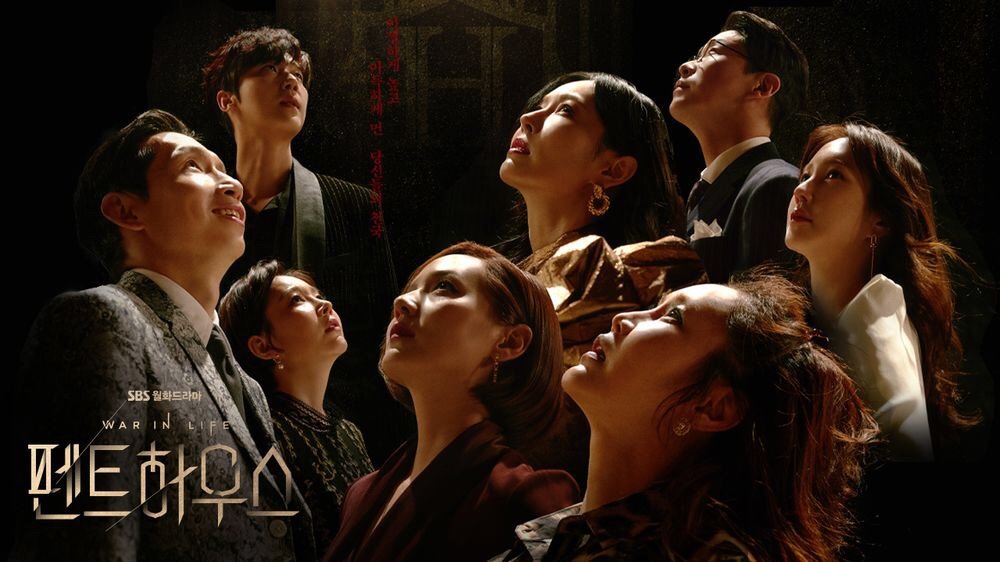
After reaching tens of thousands of views, the video later received a copyright claim from the rights holder. Instead of being removed, the monetization was redirected to the claimant.
A similar situation occurred with a Chinese drama review video that used a short trailer clip. In that case, a report from related platform resulted in a copyright strike—a formal penalty on YouTube that can lead not only to the removal of the video but also to feature restrictions on the channel and, if repeated, potential termination.
Beyond drama content, copyright issues also affect music usage. Some creators have reported that tracks from NCS (NoCopyrightSounds)—widely considered free to use—have still been claimed by third parties. In many cases, these claims are aimed at taking over ad revenue rather than removing the videos.
In contrast, a noticeable gap remains. While review videos using short clips may face claims or even strikes, other channels that upload full episodes or use misleading thumbnails often continue operating without immediate consequences.
Many of these videos remain monetized and attract tens of thousands to millions of views, raising concerns about the consistency of enforcement on the platform.
For smaller creators, disputing such claims can be challenging. Without legal knowledge or access to professional support, they are often at a disadvantage. In many cases, the system tends to favor the claimant during the initial stage.
This situation highlights a broader paradox within YouTube’s ecosystem: content that clearly appears to violate copyright can continue to circulate and generate revenue, while legitimate review content faces a higher risk of claims and penalties.
Chinese dramas products
Rosy Zhao Rosydoedian Authentic Dachshund Plush Doll Squeaky Soft Stuffed Decorative Throw Pillow Collectible Gift

Authenthic Dachshund plush doll from Zhao Lusi's Rosydoedian.
It's only available for shipping to certain countries.
Official Genuine Pursuit of Jade Drama Collectible Photocards Zhang Linghe Tian Xiwei Photo Trading Cards Holiday Gift

Official genuine collectible photocards These Pursuit of Jade Drama collectible photocards are officially licensed and authentic, featuring beloved characters Zhang Linghe and Tian Xiwei. Perfect for fans seeking genuine memorabilia from the popular drama.
High-quality packaging and design Each card comes in a premium original box with clear, vibrant printing. The 100000015 measurement unit ensures precise packaging for collectors who value neat organization and presentation.
New Drama Fangs Of Fortune Official Merch Collectible Cards Zhao Yuanzhou, Wen Xiao Characters HD Photocard Cosplay Gift

Official Merchandise from Fangs of Fortune This collectible card set is officially licensed Fangs of Fortune merchandise, featuring beloved characters Zhao Yuanzhou and Wen Xiao in high-definition detail for true fans.
High-Quality HD Photocard Design Crafted with sharp, vibrant visuals, each card delivers HD photocard quality, capturing character expressions and costumes with stunning clarity and color accuracy.
