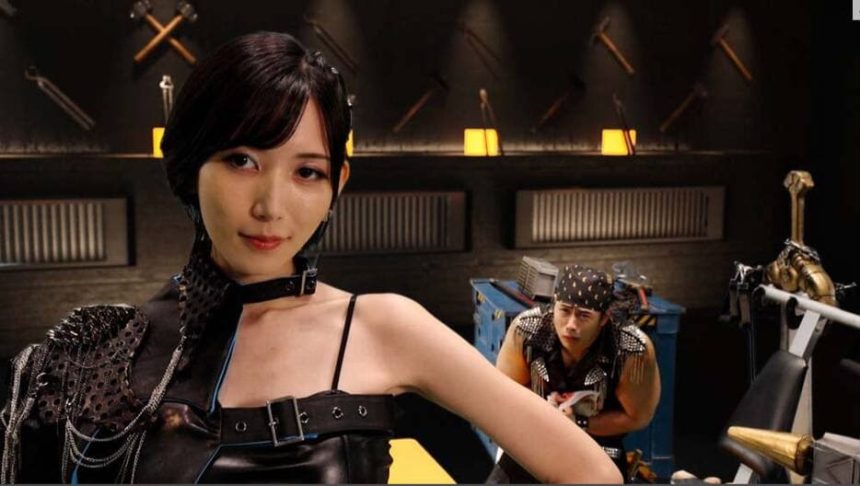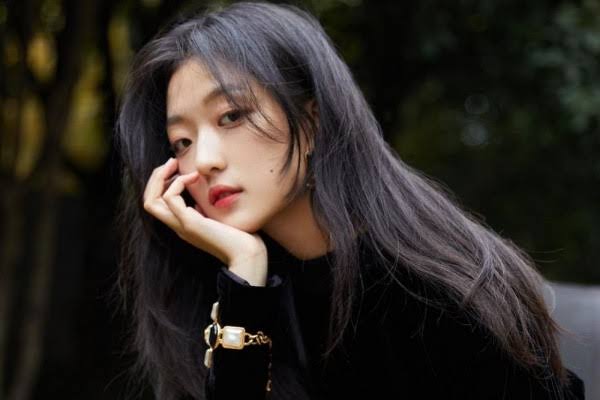
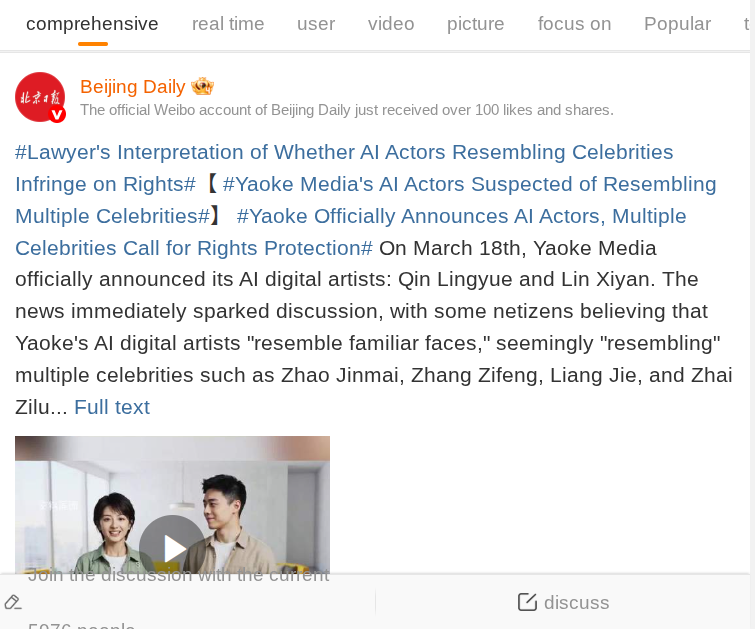
LayarHijau – Chinese entertainment company YaoKe Media officially introduced two AI-generated digital artists on March 18, Qin Lingyue and Lin Xiyan. The announcement quickly sparked widespread discussion online, particularly over how closely these AI-created faces resemble real-life celebrities.
Many netizens pointed out that the visuals feel strikingly familiar, with some claiming similarities to popular young stars such as Zhao Jinmai, Zhang Zifeng, Liang Jie, and Zhai Zilu. Some even called on these celebrities to take legal action to protect their rights.
Next articles


In response to the controversy, lawyer Gong Yue from Beijing Jinlu Ansheng Law Firm shared his legal perspective in an interview with Beijing Daily. He explained that AI-generated faces resembling real individuals could potentially constitute a legal violation, depending on the degree of similarity.
According to him, if the generated image is recognizable enough for the general public to identify a specific person, it may meet the core standard for infringement. In such cases, the creators and distributors of the content could be held liable for violating portrait rights.
He further noted that online platforms distributing such content may also bear responsibility. If they fail to promptly identify, review, and remove infringing AI-generated images, they could face joint liability and even administrative penalties.
However, enforcing the law in AI-related cases remains complex. Gong Yue pointed out that AI-generated realistic images and videos are still a relatively new phenomenon, raising multiple challenges. These include difficulties in identifying the responsible party, unclear standards for recognizability, and complications in proving causation.
In addition, the boundaries of fair use in the context of AI remain undefined. As of now, there are no specific regulations that directly address infringement caused by AI technologies.
Even so, existing laws covering portrait rights, voice rights, and personal data protection can still serve as a legal basis for determining liability in such cases. Legal practice in this area is also evolving rapidly alongside advancements in AI technology.