
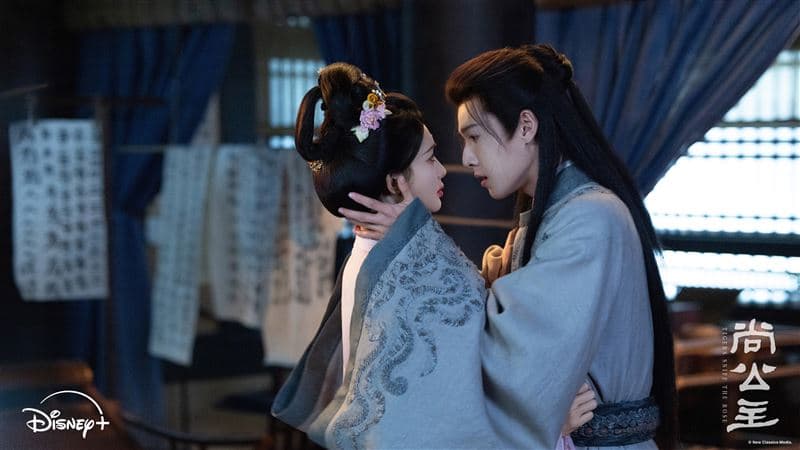
LayarHijau — The Chinese period drama Tigers Sniff the Rose (尚公主) began streaming on October 23, 2026, exclusively on Tencent Video. The 40-episode series stars Meng Ziyi as Mu Wanyao and Li Yunrui as Yan Shang. Its English title sounds poetic but says little about the story, and it differs sharply from the original Chinese title.
The drama is directed by Qin Zhen, with a script by He Fang. It is produced by Tencent Video and New Classics Media. For Meng Ziyi and Li Yunrui, it is a third collaboration, following Blossom (九重紫), which aired in late 2024.
Support Layar Hijau
Layar Hijau is an independent media outlet dedicated to sharing news and stories about the Asian dramas you love. If you enjoy our content, your support helps us keep going and bring more stories to fellow drama fans.
Every bit of support means a lot to us. Thank you for reading, following, and being part of Layar Hijau's journey.
For supporters in Indonesia

For international supporters

For more information, click here.
Mu Wanyao is the emperor’s daughter by his empress, known as Princess Danyang, and she refuses to accept her fate. On her way home from Lingnan, a region in southern China, her carriage breaks down on a mountain road. There she meets Yan Shang, a poor but brilliant scholar. Mu Wanyao then helps Yan Shang launch his career in government. Together they take on threats from both inside and outside the empire.
Based on a web novel
The drama is adapted from a web novel of the same name by Yi Ren Kui Kui, published on the online literature site Jinjiang Literature City. The original title, Shang Gong Zhu, literally means ‘to marry the princess.’
The word shang here does not carry its everyday meaning. In ancient China, a man who married a king’s daughter was said to shang gong zhu. The historical text Shiji (‘Records of the Grand Historian’) uses the same term for Gong Shu, a prime minister said to have married a princess of the state of Wei. The original title therefore focuses on the relationship between the leads: a man of humble origins who will eventually marry the princess.
What the English title means
The English title is not a translation of the original. It shifts from the relationship between the characters to a picture of their personalities.
That picture describes a person who is fierce and gentle at the same time. The tiger stands for courage, resolve, and ambition. The rose stands for sensitivity, tenderness, and an eye for beauty. The idea is not merely having two traits, but two traits that live side by side in one person.
The phrase became popular in the Chinese-speaking world through an essay by the poet Yu Kwang-chung (Yu Guangzhong). He illustrates the two sides of a person with concrete images. One side is like an eagle, a waterfall, and a raging horse. The other is like a nightingale, a still pond, and a docile lamb. In his view, the tiger lets a person stand firm against the current, while the rose lets a person notice what is subtle and hidden. Without the rose, the tiger turns coarse and blind to beauty. Without the tiger, the rose turns timid. Yu reads the verb “sniffs” as a sign of how the two sides relate: in harmony and as one. A person who has both, he writes, can be still or moving, bend or stand tall, smile or weep.
In everyday Chinese usage, the phrase is also applied to love: a strong person turns gentle when falling for someone, approaching carefully, as if afraid of disturbing the dew on a petal.
The phrase is believed to come from a line by English poet Siegfried Sassoon: In me the tiger sniffs the rose. The line comes from his poem about the past, present, and future meeting within the poet himself. Yu Kwang-chung rendered it in Mandarin as xin you meng hu, xi xiu qiang wei (心有猛虎,细嗅蔷薇), which he described as a rough translation. The Chinese version later became better known in China than the original poem.
Applied to the story, both sides can be read in the two leads. Mu Wanyao refuses to accept her fate and is driven by ambition, so the tiger side is plain in her. Yan Shang comes across as a gentle scholar, but he is sharp and calculating. This reading is LayarHijau.com’s interpretation of the synopsis, not an official explanation.
As of this writing, LayarHijau.com has found no official statement from the production team or the novel’s author saying that Sassoon’s poem is the source of the title. The link rests on the match in wording and on imagery used in the drama’s promotion.
Tiger imagery does appear in the promotion. In promotional text circulating on Weibo, Mu Wanyao is described as a tiger biding its time, and Yan Shang as a crane standing tall. On October 17, Meng Ziyi posted a line on Weibo in her character’s voice: “In my heart there is a tiger; even a cornered beast is a hunter. I am Mu Wanyao, and in this story, I am the law.” The line does not mention a rose, but it opens with the same words as Yu Kwang-chung’s translation.
On Weibo, a fan post also used a hashtag claiming the English title of the drama is that same tiger-and-rose phrase. This suggests some Chinese viewers read the title through that line.
English titles are often inspired by songs and poems
Borrowing a well-known English phrase for a title is nothing new for Chinese dramas. A frequently cited example is Put Your Head on My Shoulder, a 2019 romance whose title is identical to a 1959 song by Paul Anka. A similar case is Somewhere Only We Know, a 2019 iQIYI drama that shares its title with a song by the British band Keane. Another is Stand By Me, a 2021 Mango TV historical drama named the same as Ben E. King’s classic song.
These cases show that English titles are often chosen independently of the original titles, using phrases already familiar to international viewers. Tigers Sniff the Rose goes in the same direction, but its source is a poem rather than a song. What it borrows is one line from Siegfried Sassoon’s work, not the title of a work.
LayarHijau.com found no official statement from any of the producers on whether these titles were deliberately taken from songs. For that reason, the connection between a drama and a song of the same name is best reported as a shared title, not as a confirmation from the production.
Chinese dramas products
Rosy Zhao Rosydoedian Authentic Dachshund Plush Doll Squeaky Soft Stuffed Decorative Throw Pillow Collectible Gift

Authenthic Dachshund plush doll from Zhao Lusi's Rosydoedian.
It's only available for shipping to certain countries.
Official Genuine Pursuit of Jade Drama Collectible Photocards Zhang Linghe Tian Xiwei Photo Trading Cards Holiday Gift

Official genuine collectible photocards These Pursuit of Jade Drama collectible photocards are officially licensed and authentic, featuring beloved characters Zhang Linghe and Tian Xiwei. Perfect for fans seeking genuine memorabilia from the popular drama.
New Drama Fangs Of Fortune Official Merch Collectible Cards Zhao Yuanzhou, Wen Xiao Characters HD Photocard Cosplay Gift

Official Merchandise from Fangs of Fortune This collectible card set is officially licensed Fangs of Fortune merchandise, featuring beloved characters Zhao Yuanzhou and Wen Xiao in high-definition detail for true fans.
