LayarHijau – Actress Ha-young has apologized over the controversy surrounding her great-grandfather, doctor Ahn Sang-ho, whose activities during Japan’s colonial rule of Korea have come under renewed scrutiny.
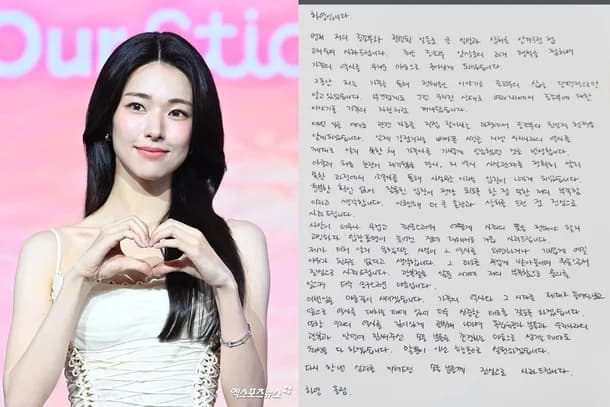
On August 12, Ha-young posted a handwritten letter on social media, expressing regret for having spoken about her great-grandfather’s life as a source of family pride without fully understanding his historical record.

“I sincerely bow my head and apologize for causing great disappointment and hurt over matters concerning my great-grandfather,” Ha-young wrote.
She explained that she had only known fragments of Ahn Sang-ho’s life through stories passed down by her family. Without a proper understanding of the historical context, she admitted that she had spoken about him on several occasions as though his story were something the family could be proud of.
“Sadly, while I was ignorant of the full facts, I brought up stories about my great-grandfather on several occasions as something my family could be proud of,” she wrote.
After the controversy emerged, Ha-young said she began researching her family history and reviewing relevant historical records. It was during that process, she said, that she learned about her great-grandfather’s pro-Japanese activities.
“While looking through various records related to the matter, I learned about my great-grandfather’s pro-Japanese activities,” she said.
Ha-young stressed that her lack of knowledge did not excuse her from taking responsibility or treating the history lightly.
“I do not believe that the fact that I did not know about it can be a reason to ignore or take that history lightly. As his descendant, I sincerely apologize,” she wrote.
She also addressed an earlier statement released through her family when the controversy first broke. Ha-young acknowledged that she did not have a clear understanding of the facts at the time and that an apology had been issued through her family before the matter had been sufficiently verified.
“I believe it was also my fault that an inaccurate position was communicated without sufficient verification,” she wrote.
She expressed regret that the earlier response had caused even more confusion and hurt. Ha-young also apologized for taking time to make a direct statement, explaining that she needed time to consider how to properly address such a serious matter.
Controversy Began With Stories About Her Family
The controversy surrounding Ha-young’s family history emerged after she discussed her family background on several entertainment programs.
On one occasion, Ha-young said that she and her older sister came from a family of doctors spanning four generations. She also spoke about her great-grandfather, saying that he had treated Emperor Gojong, the final ruler of the Joseon Dynasty and the first emperor of the Korean Empire.
Although Ha-young did not identify her great-grandfather by name during the broadcast, claims later emerged that the person she was referring to was doctor Ahn Sang-ho. His historical record during the period of Japanese colonial rule subsequently came under renewed public scrutiny.
Ahn Sang-ho was known as the first Korean to obtain a medical license in Japan. After returning to Korea, he opened a Western-style medical practice in Hanyang and later served as a physician to members of the royal family.
Before Korea was formally annexed by Japan in 1910, Ahn Sang-ho was active in several organizations and medical initiatives. He also served as vice chairman of a medical research organization established in opposition to the dominance of Japanese doctors.
However, after Korea came under Japanese colonial rule, Ahn Sang-ho’s name appeared on the council of the Daejeong Chinmokhoe in 1916. The record has since been cited in discussions of his pro-Japanese activities.
His name also appeared in the Maeil Shinbo, a newspaper that served as an official publication of the Japanese colonial government in Korea. He was reportedly presented as a symbol of Japanese-Korean assimilation after marrying a Japanese woman.
Ahn Sang-ho has also been linked to allegations surrounding the death of Emperor Gojong. Gojong’s youngest daughter, Princess Deokhye, was reportedly suspicious of Ahn Sang-ho in connection with her father’s death.
However, claims that Ahn Sang-ho was involved in Gojong’s murder or poisoning have not been established as historical fact. There is no conclusive historical evidence proving that Ahn Sang-ho personally administered poison to Gojong.
Ha-young Vows to Learn More About History
In her letter, Ha-young said she would use the controversy as an opportunity to study her family history and Korea’s history more deeply.
“I will carry this painful experience with me. I will take a closer look at my family’s history and the era in which they lived, and I will be more careful in how I approach history from now on,” she wrote.
She also pledged to study Korean history more seriously and honor the independence activists and everyone who contributed to Korea’s liberation and the well-being of the country.
“I will do my best to honor the independence activists and everyone who worked for our country’s liberation and well-being. From now on, I will put these words into action,” she said.
Ha-young also expressed regret that the controversy had arisen at a time that was supposed to be a happy period in her life.
“I am deeply sorry for causing this controversy because of my shortcomings, especially at a time when I was approaching something that should have been a happy occasion,” she wrote.
She promised to be more thoughtful when discussing both her family history and Korea’s past, while emphasizing that she would not allow her apology to end with words alone.
Controversy Affects Her Drama Projects
The controversy has also drawn attention to Ha-young’s ongoing and upcoming drama projects.
Netflix reportedly canceled a scheduled interview with Ha-young for Our Sticky Love, which was set to take place on August 14 as part of the drama’s promotional activities.
The drama has been receiving significant attention, including after reaching the top spot among Netflix’s most-watched series in South Korea. However, the controversy surrounding its lead actress has affected its promotional activities.
The situation has also raised questions about Ha-young’s upcoming SBS drama The Long Shot Trial, in which she stars alongside Lee Je-hoon.
SBS has reportedly been monitoring the situation as production of The Long Shot Trial nears completion. Most of the drama has already been filmed, and there has been no report of a change to its planned broadcast schedule.
Ha-young ended her handwritten letter by once again apologizing to everyone who had been hurt by the controversy.
“Once again, I sincerely apologize to everyone who has been hurt,” she wrote.