
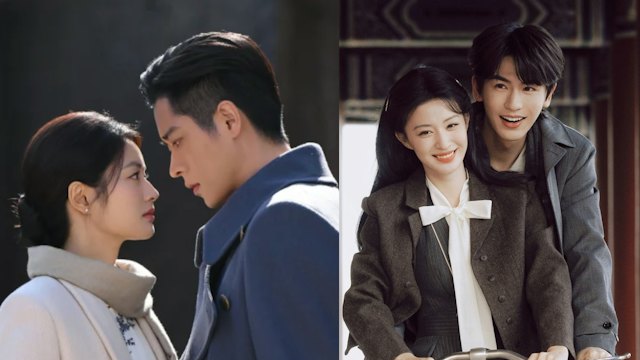
LayarHijau — The Republican-era drama The Lament of Autumn (玉簟秋), starring Cheng Lei and Xu Ruohan, has just wrapped up its 40-episode run. Its ending has been widely discussed on Chinese social media. Viewers have linked it to Overdo (这一秒过火), another Republican-era drama starring Zhang Linghe and Wang Churan that also ended tragically. The two dramas have revived a saying among Chinese drama viewers that of every ten love stories in Republican-era dramas, nine end in sorrow. Hong Kong 01 looked at the reasons behind it.
The Republican era refers to the period of Chinese history from 1912 to 1949, a time when the country was torn by war and political upheaval.
Support Layar Hijau
Layar Hijau is an independent media outlet dedicated to sharing news and stories about the Asian dramas you love. If you enjoy our content, your support helps us keep going and bring more stories to fellow drama fans.
Every bit of support means a lot to us. Thank you for reading, following, and being part of Layar Hijau's journey.
For supporters in Indonesia

For international supporters

For more information, click here.
Spoiler warning: this article discusses the endings of both dramas.
The Ending of The Lament of Autumn
The Lament of Autumn is adapted from a novel by mainland Chinese author Ling Xi, part of her “Republican-era trilogy” and published under the same title. The title comes from a line by Li Qingzhao, a female poet of the Song Dynasty.
The story follows Ye Pingjun (Xu Ruohan), a student from a poor family who works to pay for her mother’s medical care. She is unwittingly drawn into an assassination attempt against the young military commander Yu Changxuan (Cheng Lei). The two make a bet that the case can be solved in ten days. The bet leads to a contract marriage. After a period of separation caused by misunderstandings, they ultimately fight side by side against the Japanese invasion.
In the finale, Yu Changxuan leads his troops in defending the Gubeikou line and dies in battle. His father, Yu Zhongquan (Zhang Fengyi), is shot and killed while shielding his son. His mother, Zhao Baoru (Xu Fan), returns to the Yu family home and dies together with the enemy. Nearly the entire Yu family army perishes as well.
Ye Pingjun is left with their young son, called Xiaoyu’er (the “er” ending is an affectionate diminutive in Mandarin). When Xiaoyu’er asks when his father will come home, Ye Pingjun answers, “When the maple leaves turn red, Daddy will come home.” She keeps waiting, even though Yu Changxuan will never return.
According to HK01, the drama version cut some of the novel’s most heartbreaking plot points. Even so, the ending remains tragic and moved many viewers to tears.
The Ending of Overdo
Overdo is adapted from the novel Ru Guo Zhe Yi Miao, Wo Mei Yu Jian Ni (如果这一秒,我没遇见你) by mainland Chinese author Fei Wo Si Cun. The story centers on Murong Qingyi (Zhang Linghe) and Ren Susu (Wang Churan). Ren Susu returns under the alias Fang Mulan and becomes engaged to Murong Qingyi’s elder brother, Murong Qingyu, which makes her and Murong Qingyi relatives by marriage. At the same time, a grudge over the slaughter of an entire family further complicates their relationship.
The ending of this drama is described as even more brutal. Murong Qingyi dies together with the villain at a waterworks, and his body is consumed by fire. His brother, Murong Qingyu, is shot at a wedding. Division commander Tang Gongliang douses himself with flammable material and sets himself on fire so that the flames mark the location of a pharmaceutical factory for pilots in the air. The undercover agent Li Bai is killed by multiple gunshots, and his name is cleared of the traitor label only after his death.
Virtually all of the main male characters die. Only Ren Susu is left, heading south alone with her young son. To ease viewers’ disappointment, the production team released a bonus story set in a parallel universe that reunites the leads’ family.
Why Republican-Era Drama Endings Tend to Be Tragic
According to HK01’s analysis, the reason lies in the era itself. The characters live at a time when the nation is being torn apart by war, making it nearly impossible for anyone to live out the rest of their lives intact. They do not part because of a lack of love. War and the duty to defend the country force them apart, which makes the characters’ deaths feel natural rather than a device to draw tears.
The two dramas are considered effective because they avoid manufactured sentimentality. On his deathbed, Yu Changxuan recalls sweet moments with his wife. Murong Qingyi leaves behind a message: “I was always the one waiting for you. Now it’s your turn to wait for me.”
The characters’ personal fates are swept up in the tide of history. They give their lives for their country but never get to spend the rest of their lives with the people they love. What remains are those left behind, such as Ye Pingjun and Ren Susu. For this reason, the ending of Overdo is described as painful not only because the characters die, but because the survivors must go on living alone. The sorrow born of that era is said to be what keeps Republican-era dramas compelling.
Chinese dramas products
Rosy Zhao Rosydoedian Authentic Dachshund Plush Doll Squeaky Soft Stuffed Decorative Throw Pillow Collectible Gift

Authenthic Dachshund plush doll from Zhao Lusi's Rosydoedian.
It's only available for shipping to certain countries.
Official Genuine Pursuit of Jade Drama Collectible Photocards Zhang Linghe Tian Xiwei Photo Trading Cards Holiday Gift

Official genuine collectible photocards These Pursuit of Jade Drama collectible photocards are officially licensed and authentic, featuring beloved characters Zhang Linghe and Tian Xiwei. Perfect for fans seeking genuine memorabilia from the popular drama.
New Drama Fangs Of Fortune Official Merch Collectible Cards Zhao Yuanzhou, Wen Xiao Characters HD Photocard Cosplay Gift

Official Merchandise from Fangs of Fortune This collectible card set is officially licensed Fangs of Fortune merchandise, featuring beloved characters Zhao Yuanzhou and Wen Xiao in high-definition detail for true fans.
