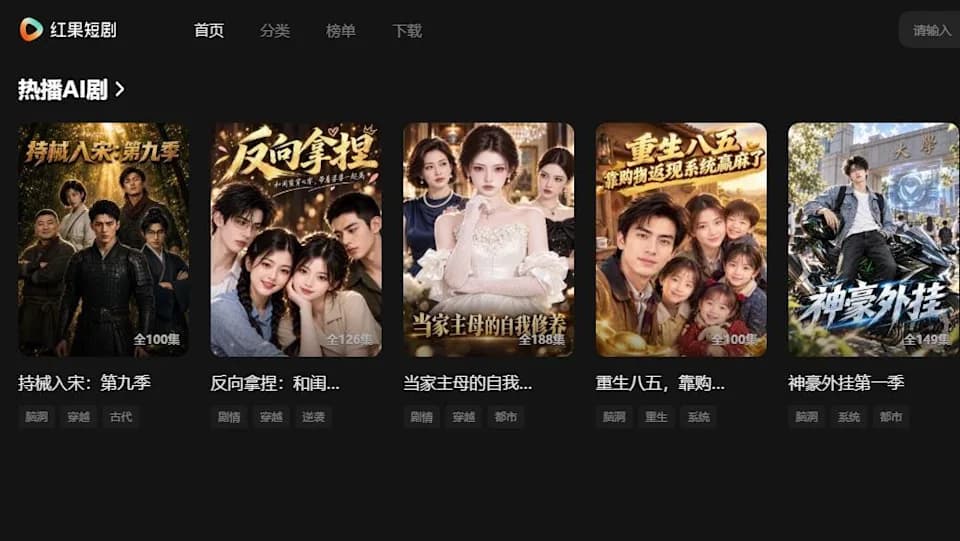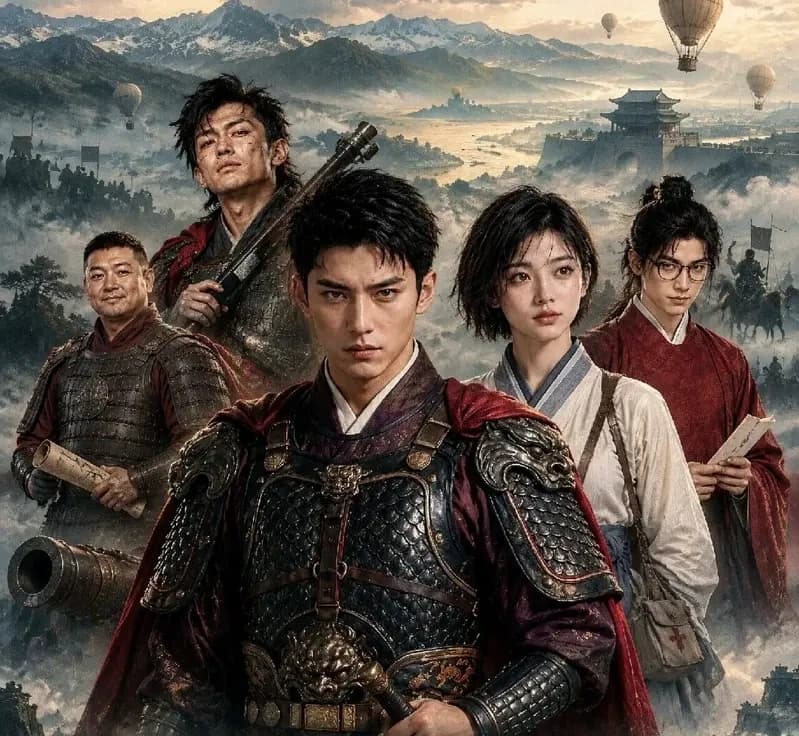
LayarHijau — AI short dramas in China are moving away from tales of domineering CEOs, time travel, and rebirth after the apocalypse. Viewers are now following stories that blend historical knowledge with modern characters thrown back into the past. The standout is Armed into the Song Dynasty (持械入宋).

soundcore P30i by Anker Noise Cancelling Earbuds
Limited time!
Check on Amazon →
Ninja Blast Max Portable Blender, Twist & Go, 22oz
Limited time!
Check on Amazon →
Chefman Air Fryer – 4 QT Compact Airfryer
Limited time!
Check on Amazon →Affiliate links. As an Amazon Associate, LayarHijau earns from qualifying purchases.
The drama streams on Hongguo, a short drama platform in China. It follows five members of a modern special forces squad who accidentally land in the Northern Song dynasty during the Xuanhe era, just as Jin forces invade from the north. They decide to use modern military knowledge and equipment to help the Song army fight off the enemy.
Its main draw is the clash between firearms and ancient armies, along with an attempt to change the Jingkang Incident, the fall of the Northern Song capital to the Jin dynasty in 1127. The story also covers the Song military system, grain and supply transport, and bureaucracy, so it is more than a shootout.
According to combined media reports, cumulative views across platforms for the first 10 seasons climbed from 4 billion and 6.6 billion early on to more than 12 billion recently. On Hongguo, total saves across all seasons exceed 14.8 million, and a single season’s peak popularity reached 82.06 million.
The effect extends beyond the screen. Some viewers who once avoided short dramas are now looking up historical records to understand the setting.
Armed into the Song Dynasty is not alone. Several other AI short dramas also send modern characters into historical worlds, with different focuses.

For political intrigue, there is The Ming Dynasty: The Unconventional Life of Li Jinglong (大明,李景隆的别样人生), set in the Ming dynasty. A modern security guard named Zheng Qian becomes Li Jinglong, an early Ming general regarded as controversial in history. With a modern mindset, he deals with Zhu Yuanzhang (founder of the Ming dynasty), Crown Prince Zhu Biao, and General Lan Yu to change his family’s fate. The series released eight seasons in six months. Its fifth season scored 8.8 on Hongguo with popularity of nearly 45 million.
The Wei Family’s Rebel Son Becomes Grand Secretary (魏家逆子成首辅) also focuses on the struggle for power in government, but through the imperial examinations. After being transported to the past, the protagonist starts as a neglected member of his family and rises to court through knowledge and strategy. The series has reached its ninth season with a total of 1.1 billion views and a score of 8.7 on Hongguo. Those results show that dialogue-driven political stories also have an audience in this genre.
From affairs of state, the focus shifts to art and culture with Yan Bian Qing Mei (砚边青梅) — Childhood Sweetheart by the Inkstone. The series is inspired by Draft of a Requiem to My Nephew, a calligraphy work by Yan Zhenqing, a calligrapher and official of the Tang dynasty, written in memory of his nephew.
A museum employee named Li Youwei travels to the 14th year of the Tianbao era (755) and becomes the childhood friend of Yan Jiming, Yan Zhenqing’s nephew. When the An Lushan Rebellion breaks out, she must decide whether she can change Yan Jiming’s fate. The story combines calligraphy, the history of the Yan family, and devotion to the country. Many viewers have since looked up the manuscript and its historical sources.
Also set in the Tang dynasty, Da Tang Han Xu Zhi Wo Jie Jie Shi Tai Zi Fei (大唐憨婿之我姐姐是太子妃) — Great Tang’s Simple Son-in-Law: My Sister Is the Crown Princess takes viewers into the imperial court. Now in its fifth season, the series features a dispute over a political marriage between states, envoys from Tubo (the ancient Tibetan empire), grain trading, and power struggles among aristocratic families.
AI technology itself has also drawn attention. Earlier this year, Huo Qubing (霍去病), named after a Western Han dynasty general, attracted wide discussion. It consists of two short war films showing Han forces advancing deep into the northern desert region to fight the Xiongnu. The work shows that AI can produce ancient battle scenes.
AI does lower the cost of producing battlefields, palaces, and ancient armies. Even so, story and characters are still what hold viewers. When audiences start looking up historical sources because of a short drama, the genre appears to be moving from instant gratification toward more substance and knowledge.
 Support on Trakteer
 Support on Buy Me a Coffee