
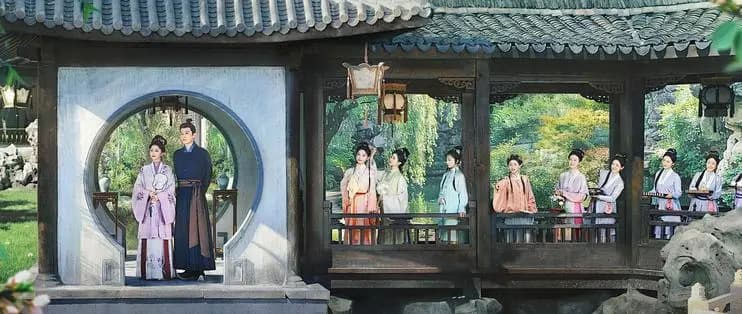
LayarHijau – The Chinese costume drama Against the Current, starring Liu Xueyi and Tan Songyun, continues to spark discussion as the story approaches its finale. One topic that has drawn attention from Chinese netizens is a theory that the names of 17 female characters are inspired by flowers or plants and may contain clues about their respective journeys and fates.
The discussion began with viewers examining the names of the female characters in Against the Current. Netizens have connected those names with the characteristics of the flowers or plants they believe they reference, then interpreted those connections as possible reflections of each character’s personality, experiences, or fate. The theory has generated considerable discussion on Chinese social media, but there has been no official statement from the writers or production team confirming that the names were deliberately designed as clues to the characters’ fates.

Sweet Osmanthus Sauce
Osmanthus sauce that is made from dried osmanthus flowers, sugar and honey.
It's perfect to make milk with osmanthus honey like what Luke makes for Flora in The Early Spring.
We earn a commission if you make a purchase, at no additional cost to yo
Against the Current is adapted from He Yanshan’s novel Lan Xiang Yuan and was developed by Tong Hua, the author of Scarlet Heart and Lost You Forever, together with Xiao Lou. As the drama nears its conclusion, viewers have increasingly focused on its smaller details, including possible connections between the characters’ names and flowers or plants.
Xu Lanxiang and Cui Xuemei
The protagonist Xu Lanxiang, played by Tan Songyun, has a name containing “lan,” which refers to the orchid. In the theory discussed by netizens, the orchid’s elegant yet resilient qualities are linked to Xu Lanxiang’s journey as she tries to hold on to her principles and identity while facing difficult circumstances.
Her mother, Cui Xuemei, has also received a similar interpretation. “Xue mei” can be associated with plum blossoms blooming in the snow. Netizens have connected this imagery with Cui Xuemei’s determination and courage in protecting her daughter.
However, the connection between the names of these two characters and their story arcs remains a netizen interpretation rather than an official explanation from the drama’s creative team.
Zhao Xingtang and Du Cuique
The names of women from prominent families have also become part of the theory. Zhao Xingtang, played by Li Meng, has been associated with the begonia flower. Begonias are known for their beauty and have also been associated in traditional Chinese culture with the expression “flower of heartache.”
Netizens have drawn a connection between this imagery and Zhao Xingtang’s journey. Although she lives amid wealth and privilege, she does not have complete control over her own fate.
Meanwhile, Du Cuique, played by Zheng Hehuizi, is the daughter of a military household. The name “Cuique” refers to delphinium, a flower known for its striking appearance but also for the toxicity of the plant.
This characteristic has led netizens to connect the flower with Du Cuique’s development in the story, particularly as her ambition to improve her social standing pushes her toward increasingly ruthless choices. Under the theory, the flower’s combination of beauty and toxicity is seen as a symbolic reflection of her character arc.
Servants’ Names Also Become Part of the Theory
The discussion among netizens does not only involve women from prominent families. The names of female servants from lower social backgrounds have also been examined for possible connections to their characters.
The servant Lü Jie’er, played by Liu Meihan, has been linked to “ji cao,” referring to houttuynia, also known as fish mint. The plant is known for its strong resilience and ability to grow vigorously. Netizens see this as a possible reflection of a lower-class character who faces pressure but continues to survive.
The servant Qingxiang is likewise associated with a wild plant that grows in fields. In the interpretation shared by netizens, this reflects a character who is loyal and capable of enduring hardship.
Gan Tang’s journey has also been cited as one of the more striking examples. After her name is considered offensive to her master’s family, she is forced to use the name “Yingge.” For netizens, the name change can be interpreted as more than simply changing what she is called—it symbolizes the loss of control over her own identity.
When Gan Tang eventually regains her original name, netizens interpret the moment as a symbol of reclaiming her identity and control over her own life.
As Against the Current approaches its finale, the theory surrounding the flower- and plant-inspired names has added another layer to the discussion among viewers. While the theory has not been confirmed by the writers or production team, it shows how Chinese netizens have been looking for connections between the characters’ names, the symbolism of flowers and plants, and the paths their characters take throughout the story.
